
Hazardous Tree Removal on Martha’s Vineyard
Controlled removal of trees that cannot be saved: over houses, across power drops, on failed root plates, and after storms.
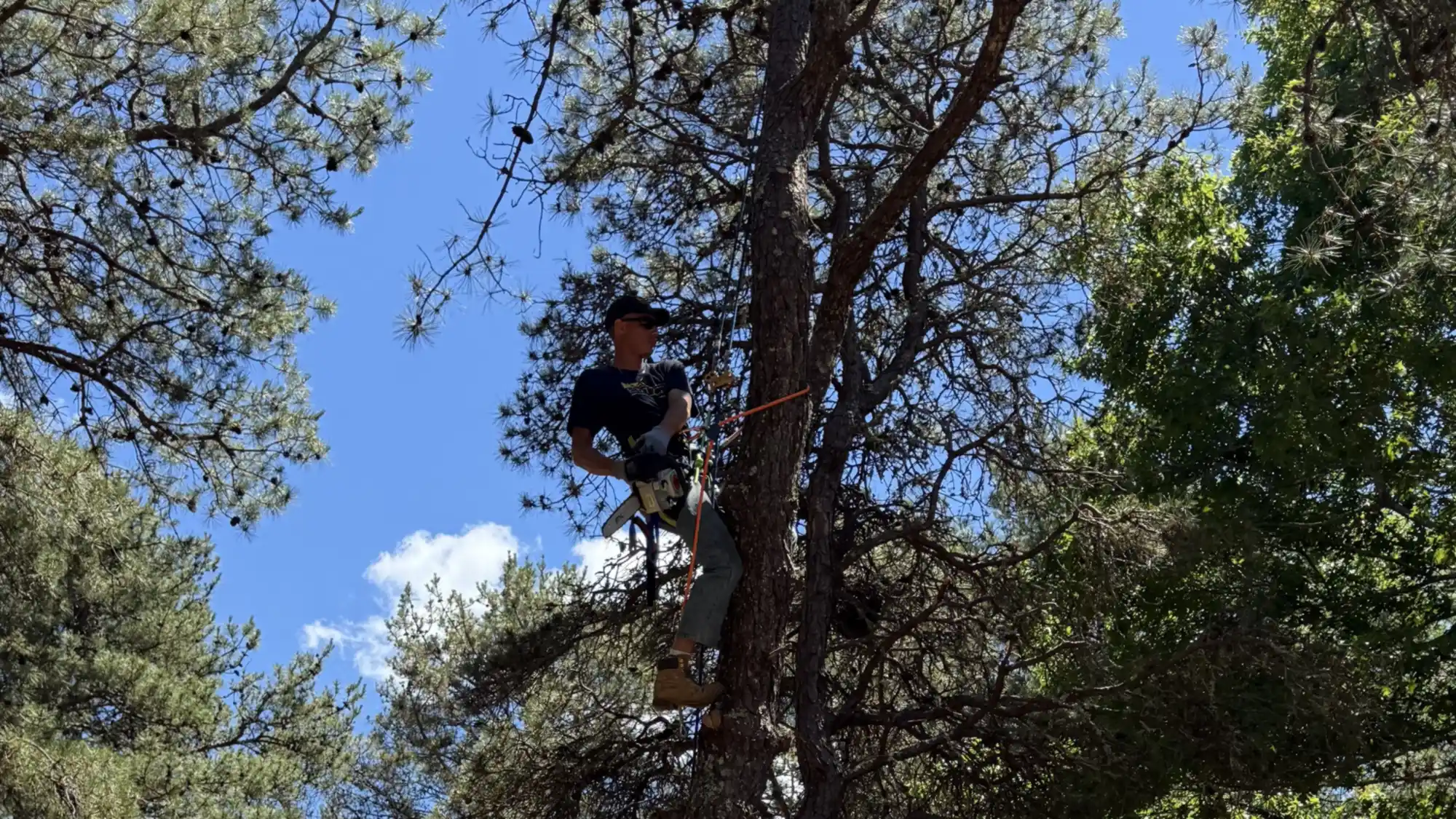
We remove trees that cannot safely stay: over houses, across power drops, on lifted root plates, and after storms. Nothing is felled; the tree comes down in rigged, controlled pieces. Storm calls on the island are answered the same day, and we are fully insured.
This is the work the company was built around, and it is the work that separates an arborist from a crew with a saw.
A hazardous removal is not felling. Nothing is dropped. The tree comes down in pieces small enough to control, lowered on rigging lines through whatever gap exists, usually over something expensive. The variables are the ones you cannot see from the ground: how much sound wood is left in the trunk, whether the root plate has already lifted, where the tension and compression are in a leaning stem, and what happens to the crown load when the first big limb comes off.
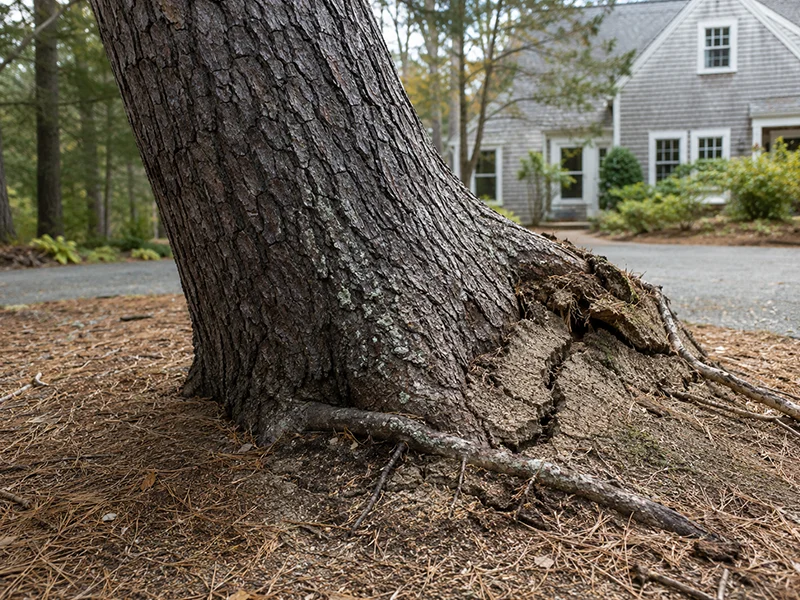
On the Vineyard the same failures repeat. Pitch pine rarely rots from the top; it goes at the root plate after a week of rain and fifty knots of wind. Black oaks fail at co-dominant unions with included bark. Leyland cypress planted as a windbreak in a line pulls straight out of sandy soil, roots and all, because it was never a windbreak species for this soil. Storm-damaged trees are the most dangerous of all, because the load in a hung-up or partially failed stem is nothing like the load in a standing one.
We are fully insured for exactly this work, and it is worth asking any tree company about their cover before they let anyone climb over your roof.
Once the tree is down and the site is raked, the ground where it stood usually needs new lawn. Our sister company, Estate Care, can lay sod or reseed the patch so it matches the rest of the yard.
What we are looking for
- The soil is lifting or cracking on one side of the trunk: the root plate is already moving and the tree is finished
- A lean that has changed since last year, especially after a wet spring
- Mushrooms or brackets at the base, meaning the butt is compromised whatever the crown looks like
- A hollow that sounds different when you knock along the trunk
- Storm damage: a hung-up limb, a split stem, or a tree leaning into another
- A dead pitch pine over a roof, a driveway or the neighbour's guest house
- Anything touching a power drop, in which case call the utility first, then call us
The job, step by step
-
Assessment
Root plate, trunk, unions, targets and access. We say plainly whether it has to come out or whether cabling buys you five years.
-
A plan on paper
Rigging points, drop zones, crew size, what gets lowered and what can be cut free. Everything protected that needs protecting.
-
Site protection
Plywood and mats over the lawn and the septic, beds screened, the drive kept clear for the chipper.
-
Rigged, not dropped
Pieces small enough to control, lowered on lines. Spikes only on a tree that is going.
-
Stump and cleanup
Grinding priced up front, chip hauled or left, the site raked before we leave.
Priced on site, not from a description
We do not publish figures, because the things that set the price are the things you cannot see from a photograph: what is left in the trunk, what the root plate is doing, what has to be rigged rather than dropped, and what a chipper can reach. The arborist looks at all of it on site, and the estimate that follows is a fixed number rather than a range. The visit is free.
What moves it up or down
- Height, diameter and how much of it has to be rigged rather than dropped
- What is underneath: an open field is a different job from a slate roof and a conservatory
- Access for a chipper and whether a crane can reach the site
- Whether the wood stays as firewood or leaves on the truck
- Stump grinding, and how close the stump is to a foundation or a utility line
- Emergency and storm call-outs, which are priced by the situation, not by a surcharge
Questions we get asked
We do not publish a figure, and anyone who quotes one before seeing the tree is guessing. What a removal costs is set by things that are only visible on site: how much sound wood is left in the trunk, whether the root plate has moved, how much of the tree has to be rigged down in pieces rather than dropped, what is sitting underneath it, and whether a chipper or a crane can get near it. A pine in an open field and a leaning oak over a slate roof are not the same job at any price.
The visit is free and takes about twenty minutes. What you get back is a fixed number for the work in front of us, not a range and not a day rate.
Yes, and we are staged on the island rather than ferrying a crew over, which is the part that matters. During a named storm event the phone is answered around the clock. If a tree is on a house, across a road, or into a power line, call rather than email, and call the utility first if there are wires involved.
It depends on the town and on where the tree stands. Work near wetlands, on a coastal bank or inside a District of Critical Planning Concern generally needs a filing with the town conservation commission. Historic districts add their own review. Many parcels also carry a conservation restriction the current owner has never read. We check all of it before quoting.
Yes. General liability and workers' compensation, both current. It is worth asking any company working over your roof the same question: if an uninsured climber is hurt on your property, that can become your problem rather than theirs.
Most single-tree removals are a day. A big rigged pine over a house, where every piece is lowered on a line, can be two. Stump grinding is usually the same visit if the grinder can reach, or a short return visit if it cannot.
The wood is your call and it is agreed up front: cut to firewood length and stacked on site, chipped and left for your beds, or taken away on the truck. Say which you want at the estimate rather than on the day and it is part of the fixed number.
Often needed alongside
Treatments & Disease Control
We diagnose and treat the pests and diseases actually killing trees on Martha's Vineyard (winter moth, southern pine beetle, oak decline, root and canker fungi) using…
What this involvesPruning & Care
We prune to the ANSI A300 standard across all six Vineyard towns: structural pruning on young trees, crown reduction and deadwooding on mature oaks and pines,…
What this involves