
Tree Pruning & Care on Martha’s Vineyard
Structural and reduction pruning to the ANSI A300 standard, plus cabling, bracing and the ongoing care that keeps an old tree standing.
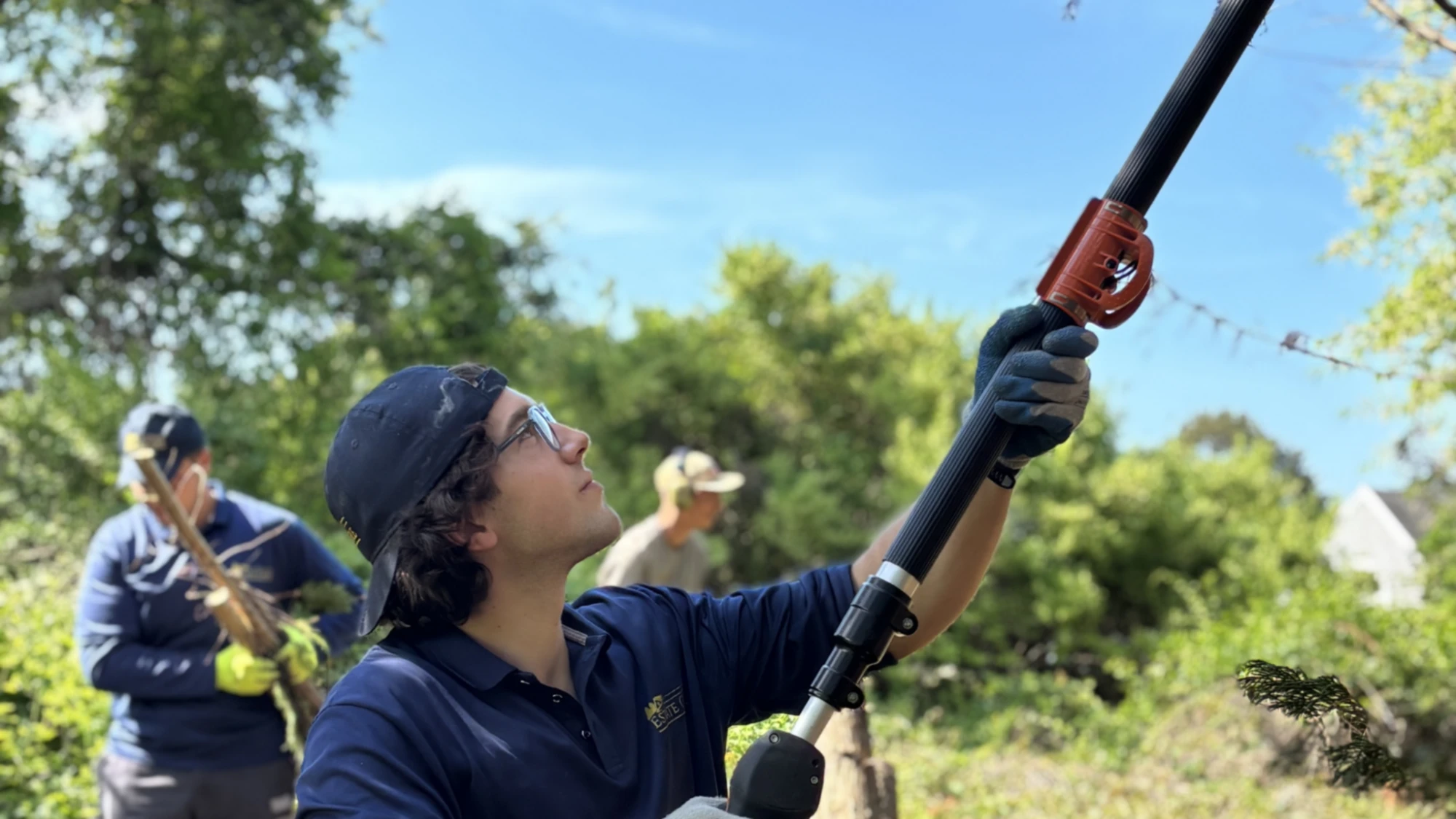
We prune to the ANSI A300 standard across all six Vineyard towns: structural pruning on young trees, crown reduction and deadwooding on mature oaks and pines, plus cabling and bracing where a tree is worth keeping. Estimates are free and usually scheduled within a week.
Pruning is the cheapest tree work there is and the easiest to get wrong. A tree that has been topped, lion-tailed or over-thinned does not recover; it responds by throwing weak, fast growth from the wound, and in six years you are paying for a removal you did not need.
We prune to ANSI A300, which in practice means every cut has a reason and a target, the branch collar, and no more than about a quarter of the live crown comes off in a season. On the Vineyard that mostly means three jobs: reduction pruning on black oaks that have grown out over a roof, deadwooding on pitch pines that have shed their lower crown, and clearance work on driveways and utility drops.
The second half of this service is care rather than cutting. Cabling and bracing on a mature beetlebung with a co-dominant stem. Crown thinning to cut wind resistance ahead of the fall storms. Soil work at the root plate on trees that are declining because of compaction, not disease. If a tree does not need pruning this year, that goes in the report too.
Hedges, shrubs and low ornamental trees are looked after by our sister company, Estate Care, as part of their shrub and small tree pruning.
What we are looking for
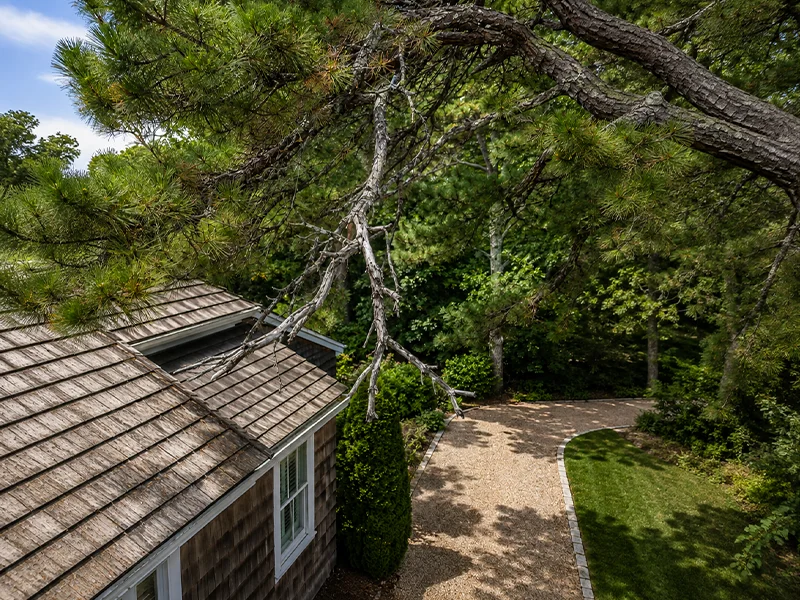
- Deadwood over a driveway, a path or a roof: pitch pine sheds its lower crown and drops it in the first hard blow
- A black oak that has grown out over the house since the last owner pruned it
- Two co-dominant stems with included bark at the union, the classic beetlebung and maple failure
- Branches into the utility drop or rubbing the shingles
- A young tree that has never had a structural prune, which is the cheapest work you will ever buy
- Crown so dense the tree acts like a sail in a nor'easter
The job, step by step
-
Assessment
We look at the whole tree first: root plate, trunk, unions, then crown. The prune follows what we find, not a fixed price list.
-
A written scope
Which limbs, which cuts, what percentage of live crown, and why. If the answer is that it does not need pruning this year, that is what the estimate says.
-
Climbing, not spiking
Spikes go into a tree we are removing, never one we are keeping. Rope and saddle, or a lift where access allows.
-
Cuts to the collar
Every cut at the branch collar so the tree can compartmentalise. No topping, no lion-tailing, no stubs.
-
Cleanup and chip
Brush chipped on site, cuts raked, and the chip left for your beds or hauled; your call, priced up front.
Priced on site, not from a description
We do not publish figures, because the things that set the price are the things you cannot see from a photograph: what is left in the trunk, what the root plate is doing, what has to be rigged rather than dropped, and what a chipper can reach. The arborist looks at all of it on site, and the estimate that follows is a fixed number rather than a range. The visit is free.
What moves it up or down
- Height and how much of the work is on rope rather than from a lift
- Access: a Chilmark driveway you cannot get a chipper down changes everything
- How long since the last prune; a tree neglected for fifteen years is two visits, not one
- Whether the chip stays on site or goes on the truck
- Proximity to a house, a power drop or anything that has to be rigged rather than dropped
Questions we get asked
Yes. General liability and workers' compensation, both current. It is worth asking any company working over your roof the same question: if an uninsured climber is hurt on your property, that can become your problem rather than theirs.
Topping removes the tree's ability to feed itself and leaves large wounds it cannot compartmentalise. The tree responds with dense, weakly attached regrowth from below the cut, so within about six years you have a denser, more dangerous tree than the one you started with, and often a removal you did not need. It is expressly against the ANSI A300 standard. For view work, selective windowing does the job and the tree survives it.
Structural and reduction pruning is best done in the dormant season, roughly November to March. The tree is not spending reserves on leaves, the wounds close cleanly as it comes into spring, and with the canopy off you can actually see the branch structure you are cutting to.
There are exceptions. Deadwood and anything hanging over a house or a driveway comes out whenever we find it. Oaks are best left alone from April to July because fresh wounds in that window attract the beetles that spread oak wilt. Storm damage is not a scheduling question at all.
About a quarter of the live crown in a season, and less than that on a mature or already stressed tree. The leaves are how a tree pays for itself; take too many and it responds with weak, fast water sprouts, which is the same damage topping does more slowly. A tree that has been left for fifteen years is usually two visits a couple of years apart rather than one heavy one, and the estimate says so.
It is the cheapest tree work you will ever buy. Twenty minutes on a young tree, picking a single leader and removing the crossing and competing limbs, prevents the co-dominant stem with included bark that fails in a nor'easter twenty years later. That failure is the single most common reason we are called to remove a beetlebung or a maple, and almost all of it was avoidable with one early visit.
Often needed alongside
Vista Pruning
We open water views by selective pruning rather than topping: windowing and limb removal in the sightline, so the woods still look like woods and the…
What this involvesTreatments & Disease Control
We diagnose and treat the pests and diseases actually killing trees on Martha's Vineyard (winter moth, southern pine beetle, oak decline, root and canker fungi) using…
What this involves