
Tree Disease Treatment on Martha’s Vineyard
Spraying, trunk injection and soil treatment for winter moth, southern pine beetle, oak decline and the other pressures that are killing island trees.
We diagnose and treat the pests and diseases actually killing trees on Martha's Vineyard (winter moth, southern pine beetle, oak decline, root and canker fungi) using trunk injection, soil application or targeted spraying. Diagnosis comes first: no treatment is sold without a cause.
Most of the trees we are asked to remove on the Vineyard did not die suddenly. They declined for three or four years while something treatable was working on them, and nobody looked until the crown was half gone.
Winter moth is the clearest example. The caterpillars defoliate oaks and maples in May, the tree pushes a second flush of leaves at its own expense, and after three or four consecutive years of that it has no reserves left. Drought or a gypsy moth year finishes it. Treated on the right calendar (dormant oil in late March, or a targeted foliar application at bud break), the same tree stays healthy.
We treat by injection where it makes sense and by spray where it does not. Trunk injection puts the material inside the tree with no drift, which matters when you are near a well, a pond, a vegetable garden or a neighbour who did not ask for any of this. Soil applications go in at the root zone. Foliar spraying is the last option, not the first, and it is timed to the pest rather than to a service calendar.
We are not going to sell you a subscription plan. If a tree does not have a treatable problem, the honest answer is that it needs water and mulch and no more compaction under the crown.
What we are looking for
- Oaks and maples defoliated in May, then leafing out a second time: winter moth, and three years running is fatal
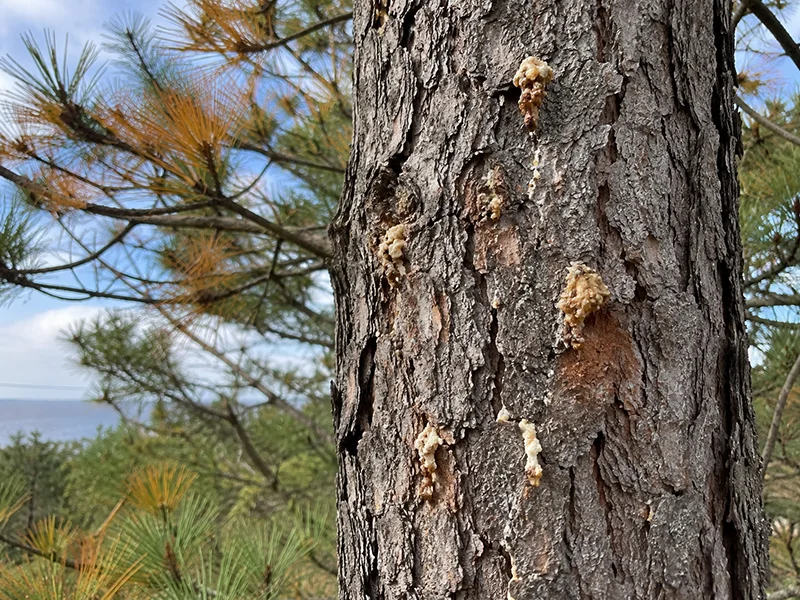
- Pitch pine with popcorn-sized pitch tubes on the trunk and fading needles: southern pine beetle
- Black oak thinning from the top down over two or three seasons
- Mushrooms or brackets at the base of the trunk, which is a root or butt rot and changes the whole conversation
- Leyland cypress browning out in patches from the inside
- Any tree that has looked slightly worse each year for three years
The job, step by step
-
Diagnosis first
We identify what is actually wrong before quoting a treatment. Sometimes the answer is drought and compaction, and no product fixes that.
-
The right method
Trunk injection where drift matters: near wells, ponds, gardens. Soil application at the root zone. Foliar spray only when timing demands it.
-
On the pest's calendar
Winter moth is a late-March dormant oil or a bud-break application. Treating in July is money burnt.
-
Follow-up
We come back and look. A treatment nobody checks is a guess.
-
What we will not do
Blanket cover sprays on a schedule, or treating a tree whose root plate has already failed.
Priced on site, not from a description
We do not publish figures, because the things that set the price are the things you cannot see from a photograph: what is left in the trunk, what the root plate is doing, what has to be rigged rather than dropped, and what a chipper can reach. The arborist looks at all of it on site, and the estimate that follows is a fixed number rather than a range. The visit is free.
What moves it up or down
- Trunk diameter, since injection is priced by DBH
- How many trees; a stand of oaks is cheaper per tree than one
- Method: injection costs more per visit than spray and lasts longer
- Whether the site needs extra care for a well, a pond or a shellfish area
- Whether it is one treatment or a two-season programme
Questions we get asked
Timing is the whole treatment. A dormant horticultural oil application in late March targets the eggs; a foliar application at bud break targets the caterpillars before they do the damage. By the time you can see the defoliation in May, that season is already lost; the useful question then is whether the tree has been hit three years running, which is the point at which it starts dying.
On site, from the ground up: the root plate and the soil around it, the trunk and any brackets or seeping, then the branch structure, then the pattern of the thinning in the crown. The pattern is usually what names the problem. Thinning from the top down reads differently from browning out from the inside, and defoliation in May reads differently from drought.
Often the honest answer is that nothing is treatable. Compaction under the crown, a raised grade over the roots or three dry summers in a row all produce a tree that looks sick and needs water, mulch and time rather than a product.
Popcorn-sized blobs of resin on the trunk, called pitch tubes, are the clearest sign, along with fine reddish boring dust in the bark crevices and at the base. The needles fade from green to yellow to red over a few weeks, usually from the top down. Once a pine is fading it cannot be saved, so the useful work is protecting the pines around it, which is why it is worth a call as soon as the pitch tubes appear rather than once a tree is red.
That is exactly why we use it. The material goes inside the trunk and moves in the tree's own vascular system, so there is no drift onto a garden, a neighbour's property, a pond edge or a shellfish area, and nothing lands on the soil above a well. On Vineyard properties, where wells, wetland resource areas and vegetable beds are usually within a few yards of the tree, injection is the default and spraying is the exception.
Sometimes, and the deciding factor is usually the roots rather than the crown. A tree that has lost canopy to three or four years of winter moth but still has a sound root plate and trunk will often recover with treatment on the right calendar plus water and mulch. A tree with brackets at the base has a butt or root rot, and no treatment reverses that; the conversation there is about how long it can safely stay and what is underneath it.
Often needed alongside
Pruning & Care
We prune to the ANSI A300 standard across all six Vineyard towns: structural pruning on young trees, crown reduction and deadwooding on mature oaks and pines,…
What this involvesHazardous Removal
We remove trees that cannot safely stay: over houses, across power drops, on lifted root plates, and after storms. Nothing is felled; the tree comes down…
What this involves