
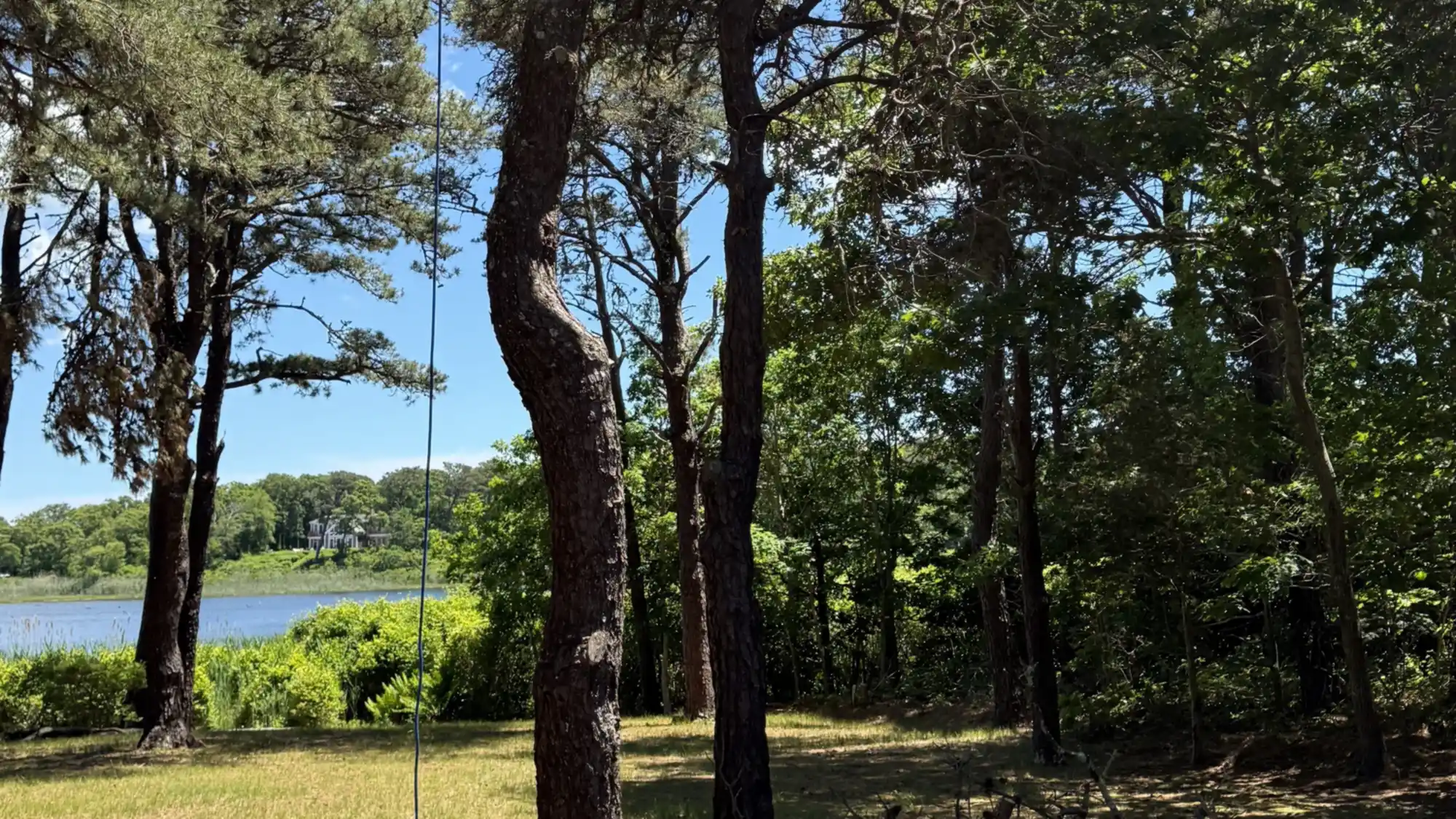
Vista Pruning & View Clearing on Martha’s Vineyard
Opening a water view without wrecking the trees or breaking the bylaw: selective, permitted, and designed to still look right in ten years.
We open water views by selective pruning rather than topping: windowing and limb removal in the sightline, so the woods still look like woods and the trees survive it. We check conservation restrictions and town bylaws before any cut, across Chilmark, Aquinnah, West Tisbury and the whole shoreline.
Vista pruning is the most misunderstood work on the island, and the easiest to get sued over.
Done properly, it is selective: you take the specific limbs that sit in the sightline from where people actually stand, and you leave a canopy that still reads as woods. Done badly, it is a hedge of topped trees with a hole punched through it, visible from the water, dead within a decade, and in several island jurisdictions illegal.
The rules matter here more than anywhere else. Much of the Vineyard shoreline sits inside a District of Critical Planning Concern. Coastal banks and dunes are regulated by each town’s conservation commission under the Wetlands Protection Act. Land Bank and Sheriff’s Meadow parcels frequently carry conservation restrictions that run with the land, and plenty of private lots have restrictions the current owner has never read. We check before anyone climbs, and if the work needs a filing we tell you that at the estimate rather than after a stop-work order.
The part people do not expect: the best vista work is mostly about limb removal low in the crown and windowing at eye height, not about height reduction. Take the top off a stand of pitch pine on a bluff and you get dense, ugly regrowth at exactly the height you were trying to see through, plus a stand with no wind resistance left.
If the ground below the new view needs low planting to keep the sightline open, our sister company, Estate Care, plants and looks after gardens across the island.
What we are looking for
- A view from the deck that has closed in over ten or fifteen years
- A new house or addition where the sightlines were never planned
- A previous crew topped the trees and the regrowth is now denser than what was there before
- A stand of pitch pine on a bluff where nobody is sure what is allowed
- A property under a conservation restriction where the last owner cut first and asked later
- Selling a property where the water view is a material part of the value
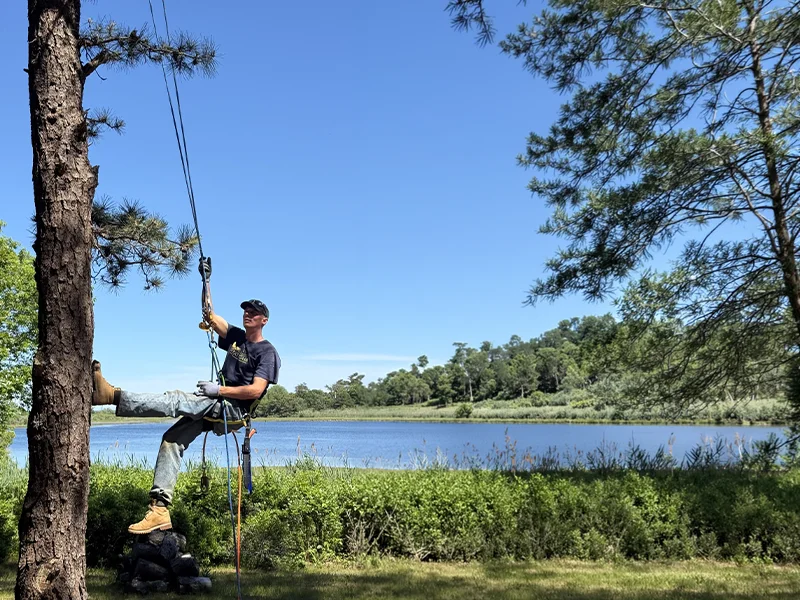
The job, step by step
-
Stand where you look from
We assess the sightline from the deck, the window, the dining table, wherever the view is actually used. Not from the lawn.
-
Check what is allowed
DCPC boundaries, the town conservation commission, Land Bank and private conservation restrictions. In writing, before anything is cut.
-
Mark the plan
Which limbs, which windows, what stays. You see the plan before we climb, and we can flag limbs for you to look at.
-
Selective cuts
Windowing and limb removal in the sightline. No topping, no shearing a hedge into the canopy.
-
Plan the next visit
Vista work is maintained, not finished. We tell you the interval, usually three to five years, at the estimate.
Priced on site, not from a description
We do not publish figures, because the things that set the price are the things you cannot see from a photograph: what is left in the trunk, what the root plate is doing, what has to be rigged rather than dropped, and what a chipper can reach. The arborist looks at all of it on site, and the estimate that follows is a fixed number rather than a range. The visit is free.
What moves it up or down
- How wide the sightline is and how many trees sit in it
- Whether the work needs a conservation filing, and how long that takes
- Slope and access: bluff work is slower and needs more rigging
- How much material has to come off the site, which on a bluff can mean carrying it out
- Whether this is a first opening or maintenance of an existing vista
Questions we get asked
It depends on the town and on where the tree stands. Work near wetlands, on a coastal bank or inside a District of Critical Planning Concern generally needs a filing with the town conservation commission. Historic districts add their own review. Many parcels also carry a conservation restriction the current owner has never read. We check all of it before quoting.
Topping removes the tree's ability to feed itself and leaves large wounds it cannot compartmentalise. The tree responds with dense, weakly attached regrowth from below the cut, so within about six years you have a denser, more dangerous tree than the one you started with, and often a removal you did not need. It is expressly against the ANSI A300 standard. For view work, selective windowing does the job and the tree survives it.
Less than a photograph from the water suggests, and usually more than you expect from where you sit. We assess from the place the view is actually used, the deck or the window or the dining table, because a sightline is specific to one viewpoint and a metre either way changes which limbs matter.
The ceiling is set by the rules rather than by the trees. Inside a District of Critical Planning Concern, on a coastal bank, or on a parcel with a conservation restriction, what is permitted is defined in writing, and we get that answer before quoting.
Not if it is done by selective limb removal. Taking specific limbs out of the sightline low in the crown, and windowing at eye height, leaves the tree its leader, its top and most of its leaf area, and a healthy stand carries that easily. What damages trees is topping a bluff-side stand to get height out of the way: you get dense regrowth at exactly the height you were trying to see through, weakly attached, on trees that have lost their wind resistance.
Three to five years for most properties, and we tell you the interval at the estimate rather than leaving you to find out when the view has gone. Maintaining an opening is a fraction of the work of making one, because it is a handful of limbs rather than a plan for a whole stand. Leaving it for fifteen years puts you back to a first opening.
Often needed alongside
Pruning & Care
We prune to the ANSI A300 standard across all six Vineyard towns: structural pruning on young trees, crown reduction and deadwooding on mature oaks and pines,…
What this involvesHazardous Removal
We remove trees that cannot safely stay: over houses, across power drops, on lifted root plates, and after storms. Nothing is felled; the tree comes down…
What this involves