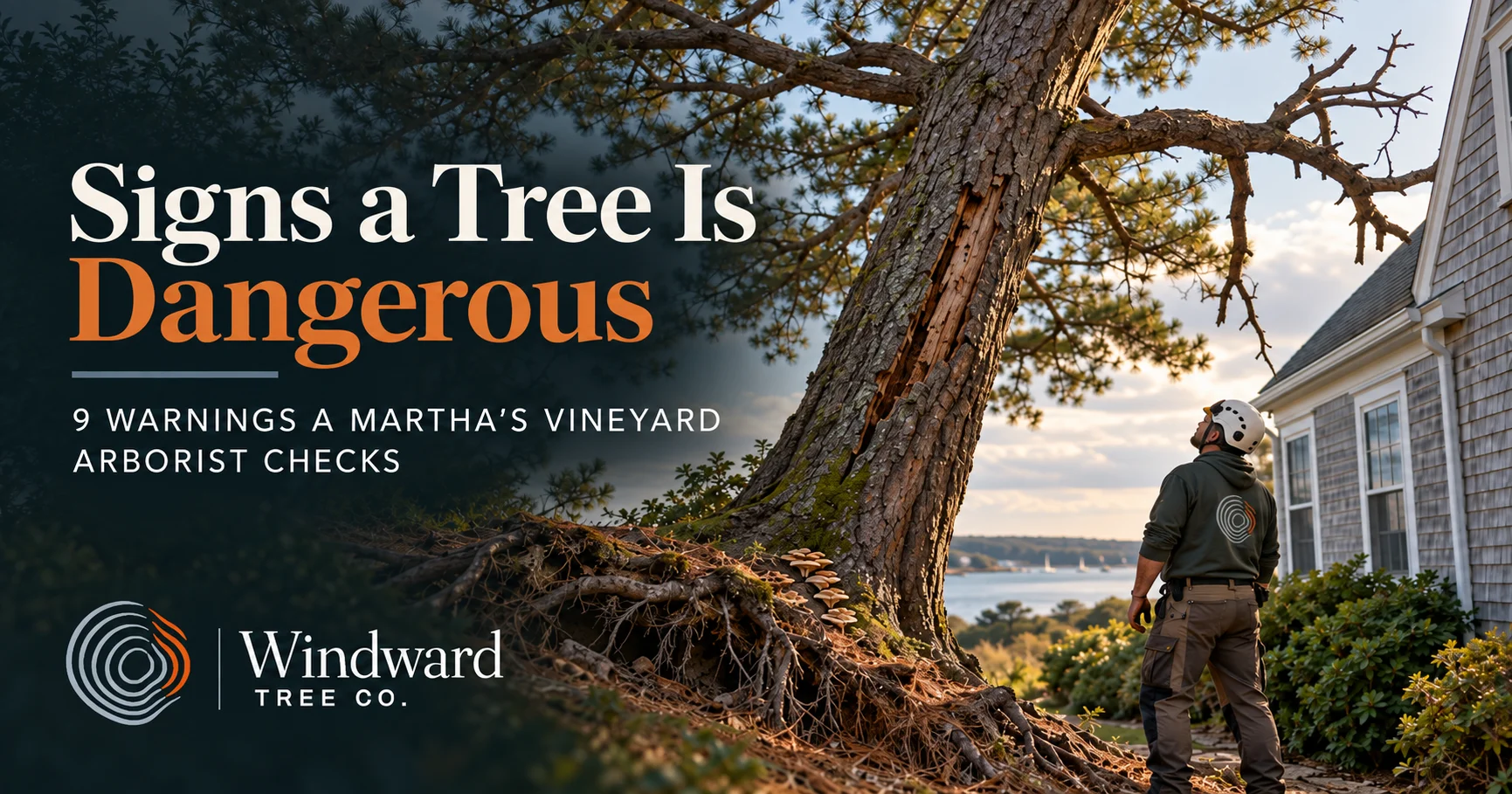
Signs a tree is dangerous, in the order a Martha's Vineyard arborist checks them: root plate, lean, fungi, cracks, dead limbs. Know when to call.
On this page
- What Are the Warning Signs a Tree Is Dangerous?
- Start at the Ground: Root Plate, Lean and Fungi
- The Trunk: Cracks, Cavities and Split Unions
- How Can You Tell if a Tree Is Dead?
- Which Island Trees Fail Most Often?
- When Should You Call an Arborist Right Away?
- What a Free Tree Risk Assessment Involves
- Frequently Asked Questions
TL;DR: The clearest signs a tree is dangerous are soil lifting on one side of the trunk, a changed lean, fungi at the base, deep cracks, split unions with bark trapped inside, and dead limbs over a roof or path. On Martha’s Vineyard, pitch pine and black oak fail most often after rain and wind. If you see any of these near a house, have a certified arborist look before the next storm.
Most trees that fall on Vineyard houses gave warnings for years. The signs a tree is dangerous are usually visible from the ground, if you know where to look and in what order. We start at the soil and finish in the crown, because that’s where the real failures on this island begin.
The timing matters this fall. A nor’easter reached the island on September 25, 2026, with gusts forecast as high as 65 mph and ferries canceled. Last February, a blizzard left more than 10,000 island customers without power, with trees and lines down in every town.
Below are the nine warnings our arborists check on every estimate, plus a table for deciding what can wait and what can’t.
What Are the Warning Signs a Tree Is Dangerous?
A tree is dangerous when a defect makes it likely to fail and something valuable sits within reach. The nine warnings are soil heaving, a new lean, fungi at the base, damaged roots, trunk cracks, cavities, split unions, dead limbs and a dead or dying crown.
The International Society of Arboriculture’s homeowner brochure lists most of them: cracks, decay, weak unions, root problems, dead branches and poor form. It also says judging how serious a defect is “is best done by a professional arborist.” The same brochure calls dead branches in the canopy the most obvious potential hazard.
A defect alone doesn’t make a hazard. A cracked pitch pine in a Chilmark field is a curiosity; the same crack above a bedroom in Oak Bluffs is a problem. Risk is the defect plus the target underneath.
Start at the Ground: Root Plate, Lean and Fungi
Four of the nine warnings sit at or below knee height, and they are the ones people miss.
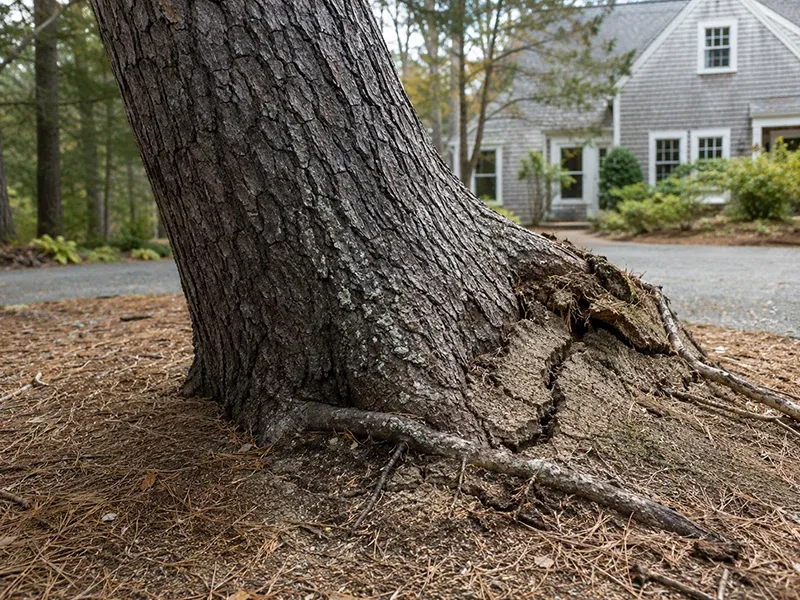
1. Soil lifting or cracking on one side. Look at the ground on the side away from the lean. A mound, a crack in the lawn or a gap around the trunk means the root plate is already moving. Penn State Extension notes that trees in wet soil can lift the root plate on the back side, and that re-anchoring a large tree after that is rarely practical.
2. A lean that has changed. Many trees grow at an angle for decades and stay sound. The worry is a lean that is new, or one that got worse after a wet spring or a storm. Compare with an old photo if you have one.
3. Mushrooms or shelf fungi at the base. A fruiting body on the trunk or roots is the visible end of internal rot. According to UC IPM, a visible fruiting body usually signals advanced decay, and the rot can run far above or below it. Penn State’s page on tree diseases that create hazards warns that oaks with one common root and butt rot “may topple before any obvious symptoms are noted.”
4. Damaged or buried roots. Trenching for a septic line, new fill over the root zone or a driveway poured to the trunk all cut the anchor. UMass urban forestry guidance lists a missing root flare, damaged buttress roots and soil mounding among the base defects worth checking.
The Trunk: Cracks, Cavities and Split Unions
Three more warnings live on the trunk and the main stems.
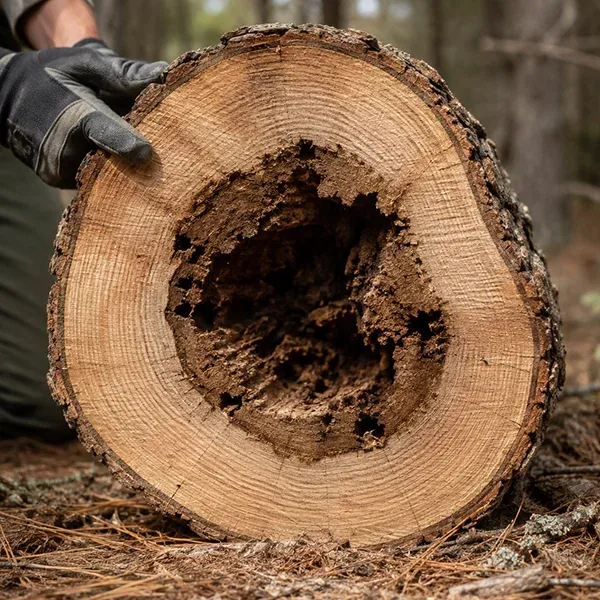
5. Cracks and splits. A long crack running with the grain means the wood is already separating under load. Cracks at the point where two big stems meet are the most serious kind.
6. Cavities and decay. A hollow, loose bark, sawdust at the base or a patch that sounds dull when you knock on it all point to decay inside. The tree can still leaf out well for years while the trunk gets thinner.
7. Co-dominant stems with included bark. Two stems of the same size forming a tight V are a classic failure point. When bark is pinched inside the union, the stems are held together by little more than bark. On the Vineyard we see it most in black oak, beetlebung (black tupelo) and red maple.
How Can You Tell if a Tree Is Dead?
A dead tree drops no leaves in fall because it grew none in spring, keeps brown needles through winter, and sheds bark in sheets. The quickest check is a small scratch on a twig or the trunk: green underneath means living tissue, brown and dry means dead.
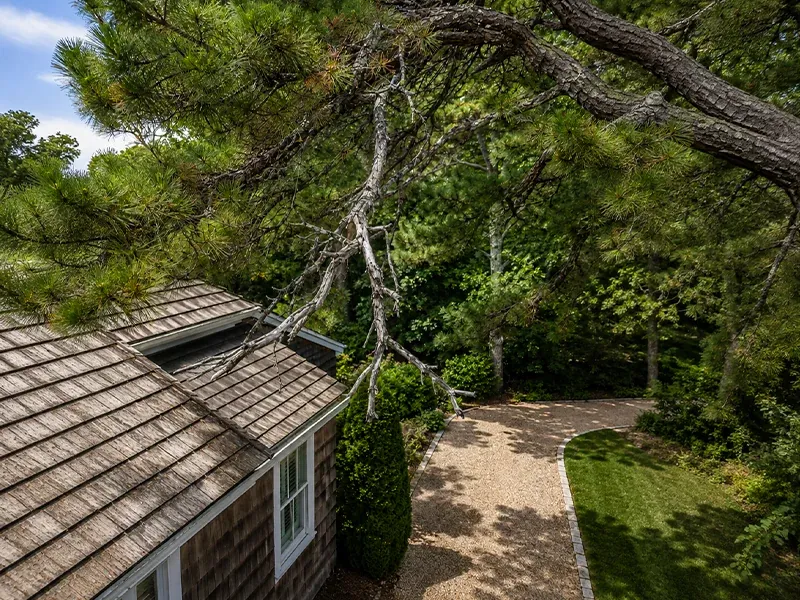
8. Dead limbs and hangers. Look for bare limbs above a roof, deck, driveway or path. Broken limbs caught in the crown after a storm, called hangers, can drop without warning days later.
9. A dead or dying crown. For the scratch test, remove a thin strip of bark with a fingernail. Gardening Know How explains that the layer underneath is green in a living tree and brown and dry in a dead one. Test the trunk or a low stem, not just one twig, since a single dead branch doesn’t mean the tree is dead.
Pitch pine deserves its own check this year. The southern pine beetle reached Martha’s Vineyard in 2023, and Mass Audubon describes the signs as popcorn-shaped globs of dried pitch on the bark and needles turning orange to reddish brown. A pine that goes from green to rust in one season is dead, and dead pitch pine near a house should be looked at before the winter storms.
Which Island Trees Fail Most Often?
On Martha’s Vineyard, most failures we’re called to involve four trees: pitch pine that goes over at the root plate, black oak that splits at a weak union, Leyland cypress windbreaks that pull out of sandy soil, and pitch pine already killed by the southern pine beetle.
Pitch pine rarely rots from the top. It goes at the root plate after a week of rain loosens the sandy soil and a hard northeast wind loads the crown. That’s why our arborists look at the base of the trunk and the soil first, and the crown last.
Black oak is the island’s other big failure. Old oaks along the roads in West Tisbury and Edgartown often carry co-dominant stems with included bark, and one half can peel away in a storm with the other half still standing.
Leyland cypress was planted as a fast windbreak on plenty of island lots. It roots shallow in sandy soil, so a whole row can tip together. Browning from the inside or a group lean is one problem, not ten.
When Should You Call an Arborist Right Away?
Call right away when a defect sits over a house, a road, a play area or a power line, or when anything is touching a wire. Soil lifting on one side, a fresh split or a hanging limb after a storm all belong in the same urgent group.
Use this table to sort what you’ve found.
| What you see | How urgent | What to do |
|---|---|---|
| A limb or tree touching a power line | Call now | Stay clear and call the utility first, then us |
| Soil lifting or cracking on one side of the trunk | Call now | Keep people and cars out of the fall zone |
| A split stem or a broken limb hanging in the crown | Call now | Don’t walk or park underneath |
| Mushrooms or shelf fungi at the base or on roots | Call this month | Book an inspection before the next storm |
| A lean that has changed since last year | Call this month | Photograph it and book an inspection |
| Tight V-shaped union with bark pinched inside | Call this month | Ask about cabling or reduction pruning |
| Dead limbs over a roof, deck or path | Call this month | Deadwood removal before winter |
| Brown needles or a thinning crown | Watch and check | Look again in 2 to 4 weeks, then call |
Wires change everything. Eversource tells residents to stay clear of fallen limbs, electrical wires and anything they’re touching, and to call 911 or the utility to report downed lines. Never prune or cut near a line yourself.
What a Free Tree Risk Assessment Involves
One of our certified arborists walks the site, usually William Heath, who does most of the climbing. The visit takes about twenty minutes: root plate and soil first, then trunk and unions, then the crown and whatever the tree could land on.
You don’t need to be on the island. We arrange access with your caretaker and send photos and a written estimate.
The answer isn’t always removal. A tree with one weak union may need cabling and a re-inspection in two years, which is part of our tree pruning and care work. A declining oak may need a diagnosis and treatment for disease instead of a saw. When a tree truly can’t stay, our hazardous tree removal takes it down in rigged, controlled pieces, with nothing dropped onto the house.
Walk your trees from the ground up and take any sign over a roof, road or wire seriously. Soil lifting, fresh splits and fungi at the base all need a professional look before winter, not after. If something on your property worries you, request a free estimate and one of our arborists will come and look at it.
When a tree is already on a house, across a road or into a line, call (508) 560-6073. Call the utility first if wires are involved.
Frequently Asked Questions
Can a tree be dead but still have leaves?
Yes, for a while. A tree killed by root rot or girdling can leaf out in spring on stored energy and then wilt or brown by summer. Evergreens like pitch pine can hold dead brown needles for months. The scratch test on the trunk is a better guide than the leaves.
Should I remove a leaning tree?
Not always. A tree that has grown at an angle for years, with firm soil around its base, is often sound, while a lean that is new or getting worse usually means the roots have failed. Soil lifting on the far side settles it: that tree should come down.
Can a dead tree be revived?
No. Once the living layer under the bark is brown all the way around the trunk, the tree can’t recover, but a tree that is only partly dead or declining is different: a diagnosis can show whether treatment, pruning or better soil care will help.
What is the best time of year to inspect trees?
Each season shows something different. UMass guidance points to winter for seeing branch and trunk defects without leaves, late summer for spotting a stressed crown, and early fall for finding decay fungi at the base. A quick walk-around after every major storm is worth doing too.
Do I need to be on Martha’s Vineyard for a tree inspection?
No. Plenty of our clients are seasonal owners who are off-island when we visit. Access is arranged with your caretaker or property manager, and you get photos with a written estimate afterward.